

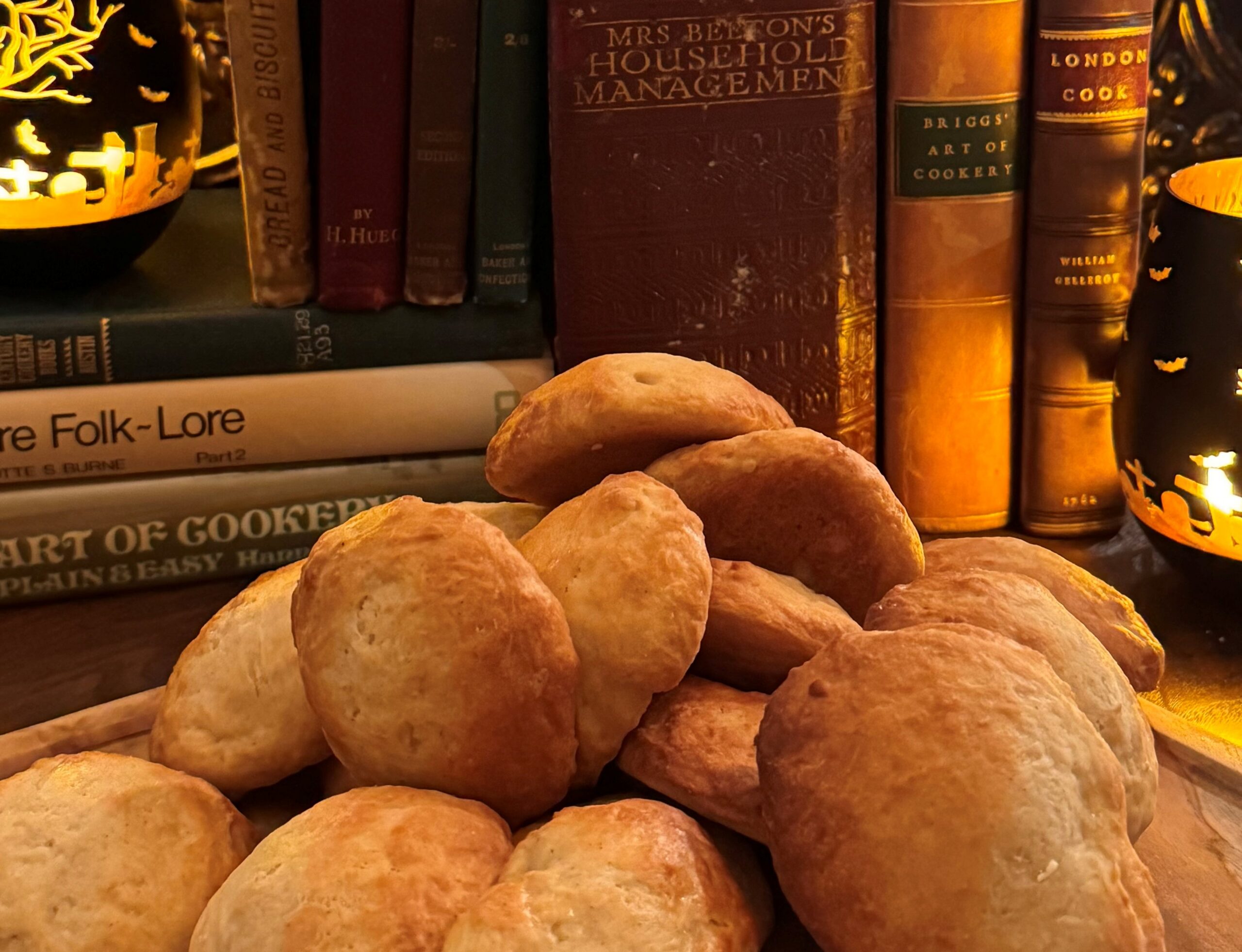

Local chef and food historian George Formaro recently baked a batch of soul cakes from one of the thousands of old cookbooks in his home library. (Photo: George Formaro)
By George Formaro
If you know me, you know I love Halloween. I also love old cookbooks, especially the ones by people who actually made their living cooking and baking.
Whenever I put those two interests together, I can spend a ridiculous amount of time trying to figure out what people were handing out at the door a few hundred years ago.
One short answer is a soul cake. But the longer answer is more interesting.
Centuries before people handed out individually wrapped, not-so- “fun”-sized candy bars, they shared the story of Stingy Jack, a guy who tricked the devil and wound up wandering in the dark with a candle inside a hollowed-out turnip. I can picture folks telling this one around the fire.
During All Saints’ Day and All Souls’ Day, many people also went from door to door in a custom called “souling.” They’d ask for a bit of bread or cake in exchange for prayers for departed family members.
So food, family and the neighborhood? Of course I’m interested.
Halloween has a lot of history tangled up in it, including the Celtic harvest festival of Samhain. (And yes, thanks to “Halloween II,” I spent decades saying it wrong. Apparently, it’s SAH-win.) But Samhain isn’t the whole story, and I haven’t found evidence that soul cakes were part of that ancient festival. The cakes I’m interested in belong to another thread of Halloween history, which ties to the Christian custom of souling.
But I don’t want to take a modern cookie, put a cross on it and suddenly call it medieval. I want to see what the old books actually tell us.
One book in my home library is “Two Fifteenth-Century Cookery-Books,” edited by Thomas Austin and published in 1888. The book itself is old, but the recipes inside are much older — so old, in fact, that they’re written in Middle English. Sometimes you can hear what the writer meant, but you have to read the recipes aloud and sound them out as you go along. To a food geek like me, this is fun.
There are fried cakes called Bryndons, wafers cooked between hot irons, and an early take on gingerbread made with honey, spices and grated bread.
None of these is identified as a soul cake. But they give us a look at what cooks were making in 15th-century England. They also remind us that “cake” hasn’t always meant what we think of today.
I love having something like that on the shelf. It’s somebody’s cooking, recorded hundreds of years ago, and here I am trying to make sense of it in my own kitchen.
My research eventually led me to “Shropshire Folk-Lore,” compiled by Charlotte Sophia Burne from material collected by Georgina Jackson and first published in 1885. It’s not a cookbook, but the second volume in my library covers a lot of food history.
And this is where things get really interesting. The book mentions seed cakes eaten at Allhallows in Warwickshire and given as presents in Northamptonshire, where they were often called “soul cakes.” According to this account, soul cakes were still being made and sold in Welshampton around 1870 and possibly later.
Made and sold. Now I’m thinking about bakers. I can picture somebody at a flour-covered bench making an extra batch because families would be coming in to buy cakes for the folks knocking on their doors.
The account doesn’t name a bakery. That picture is mine. But the fact of cakes for sale is in the record.
Then there’s a Mrs. Gill of Hopton, England, who had soul cakes made in her house every year for the children who came souling. The tradition continued until her death in 1884, and her family preserved the recipe: flour, butter, sugar, yeast, eggs, allspice, fresh milk.
Now we’re getting somewhere: a fermented dough, something I’d expect to eat more like a lightly sweetened bun than a crisp little cookie.
The original recipe calls for 3 pounds of flour, a quarter pound of butter, half a pound of sugar, two spoonfuls of yeast, two eggs, allspice and enough milk to make a light dough. And if you wanted them extra rich, you could double the butter. (I like that detail. Even in this little recipe, somebody was deciding how generous they could be with the ingredients.)
The instructions have you let the dough rise by the fire before adding the sugar and spice. Then you shape the cakes flat and bake them. The later addition of the sugar and spice caught my attention. That’s something I’d want to try both ways.
No oven temperature. No exact milk quantity. No explanation of how big those spoonfuls of yeast were. In older cookbooks, you were expected to know a few basics.
In “The Art of Cookery Made Plain and Easy,” first published in 1747, author Hannah Glasse shares a recipe for a cheap seed cake made with flour, butter, milk, sugar, allspice and ale yeast. You let it rise by the fire, then add currants or caraway seeds before baking.
There it is again: a cake made with yeast.
I like that she gives you a choice. Seeds or currants. Even the seed cake doesn’t require seeds.
Another book on my shelf is Richard Briggs’ “The English Art of Cookery,” first published in 1788. Briggs had cooked at the Globe Tavern and Temple Coffee House in London and the White Hart Tavern in Holborn. His workplaces are listed right there with his name.
That gets my attention. Here’s a cook whose introduction is basically a list of the places where he worked. I understand that. In our business, somebody asks where you’ve cooked, and pretty soon you’re talking about kitchens, people and all the things you learned along the way.
His book has a seed cake, too: flour, butter, milk, sugar, allspice, yeast and caraway.
I’m not saying either Glasse or Briggs called their versions soul cakes. But when the folklore mentions seed cakes, their books give me actual recipes to put beside that description. That’s useful, and it’s a lot more interesting to me than guessing what an old cake ought to look like.
Then there are the later baking books, like Robert Wells’s “The Bread and Biscuit Baker’s and Sugar-Boiler’s Assistant.” My 1890 second edition includes tea cakes made with a sponge, sugar, fat and currants.
Frederick T. Vine’s “Cakes and How to Make Them” from the late 1800s has a whole section for “fermented or dough cakes.” That heading alone tells you something. Some cakes are plain. Others have more sugar, fat, fruit and spice. Working bakers made different products for different customers, at different prices.
Neither book establishes that its tea cakes were sold as soul cakes. But they help me understand the kind of dough that Mrs. Gill made. These were familiar baking methods, used by people who did this for a living.
And that’s the part I keep coming back to. I’ve spent more than 40 years feeding people. I can’t help being interested in the people who did this before me. What they made. What they charged. What the neighborhood looked forward to.
I know I’m romanticizing it a little. I’m a baker. Let me have that.
Hannah Glasse’s Cheap Seed Cake
Ingredients
Flour, half a peck
Butter, 1½ pounds
Sugar, 1 pound
Milk, 1 pint
Good ale yeast, ½ pint
Ground allspice, ½ ounce
Currants or caraway seeds
Instructions
Warm the butter and milk together until the butter melts.
Mix the sugar and allspice with the flour, then work in the milk, butter and ale yeast.
Let it rise by the fire.
Add the currants or caraway seeds before baking. Divide into two cakes and bake in a quick oven for about an hour and a half.
George’s note: These are her old measures and directions. A peck is a measure of volume, and that ale yeast isn’t the same as a half pint of our dry yeast. This recipe needs some interpretation before we use it in a modern kitchen.
But look at what’s there: butter, milk, sugar, allspice and a fermented dough. You can see why I wanted it beside Mrs. Gill’s recipe.
Mrs. Gill’s Soul Cakes
A modern working version
If you’re interested in making one of these cakes, start with this one because the recipe was actually preserved with the “souling” custom mentioned by name, which is cool.
Yield: about 16 small cakes
Ingredients
Bread flour, 680 grams (approximately 5½ to 5¾ cups)
Butter, 4 tablespoons (8 tablespoons for the richer version)
Sugar, ½ cup plus 1 tablespoon
Instant yeast, 2¼ teaspoons
Egg, 1 large
Whole milk, 1¼ cups, with a little more if needed
Ground allspice, 1 teaspoon
Fine salt, 1½ teaspoons
George’s note: The salt is my addition. It helps control the fermentation and gives the dough some strength and flavor. The instant yeast quantity, temperature and baking times are modern working choices, too.
Instructions
Warm the milk until just lukewarm.
Mix the milk, yeast, egg and about half the flour. Let that stand for about 30 minutes.
Add the remaining flour and salt. Mix, then work in the softened butter. Knead until you have a reasonably smooth dough. Add a little more milk if it feels stiff. You want it soft.
Cover and let it begin rising, about 45 to 60 minutes in a warm kitchen.
Work in the sugar and allspice. This gets a little messy before it comes back together. Keep mixing.
Rest about 20 minutes, then divide into 16 pieces. Round them and flatten them into small cakes.
Put them on greased baking sheets and let them rise until noticeably light and puffy. Go by the dough.
Bake at 375 degrees for about 15 to 20 minutes.
George’s note: I’d leave them plain. Don’t add icing or currants, at least in the first batch, since Mrs. Gill’s original recipe doesn’t call for them.
You can play with it later. I’d like you to taste it this way first. That’s what I’m after here: something we can actually connect to the custom, then get into the kitchen and try.
It doesn’t answer what every soul cake looked like. Different families and different places had their own ways of doing things. I doubt every baker agreed on the recipe any more than we agree on pizza dough now.
But we have a place to start. And I love the thought of making a few extra and giving them away.
At Halloween, I love the candy, the cheap decorations, the monster movies and the haunted houses. All of it. But there’s room for this part of Halloween, too.
Somebody makes something. Somebody knocks on the door. A little food changes hands, along with a song or a prayer or the memory of somebody who’s gone. That’s a story I’d like to keep around.
If you have an old British or Irish baking book with a soul cake recipe in it, I’d love to see it. I’ve found seed cakes, tea cakes and all kinds of fermented cakes. But so far, Mrs. Gill’s is the one recipe I’ve found that specifically preserves the souling custom.
I’m still looking.
Contributing writer George Formaro is a six-time James Beard Award nominee, chef partner with Orchestrate Management and the culinary mastermind behind Centro, Gateway Market, South Union Bread Cafe and Zombie Burger + Bird.




Show Comments (0)